
Lanai Floor Coating Options Built to Last

A lanai floor takes a different kind of beating than an indoor room. It sees humidity, tracked-in grit, wet shoes, patio furniture, pool water, and intense sunlight near open walls or screen enclosures. That is why choosing between lanai floor coating options should never come down to color alone. The right system must bond hard to the concrete, handle moisture, and keep its finish through years of everyday use.
A professionally coated lanai can turn stained, dusty, or cracked-looking concrete into a cleaner outdoor living space. But a weak coating can peel, chip, fade, or become slick after the first stretch of harsh weather. Don’t settle for a surface that looks good only on installation day.
What a Lanai Floor Must Handle
Lanais in Central Florida live in a demanding environment. Even when a space is screened and covered, moisture remains a constant concern. Humid air, wind-driven rain, condensation, pool traffic, and damp furniture legs can all affect a floor over time.
Concrete itself adds another challenge. It is porous and can hold moisture below the surface. If a coating is installed over improperly prepared concrete, pressure from that moisture can push against the coating and weaken its grip. This is one of the main reasons cheap paint jobs and lightly prepared epoxy floors fail early.
Sun exposure matters too. A lanai may be protected from direct rainfall but still receive strong UV exposure at its edges. Some materials yellow, chalk, or lose their color when exposed to sunlight. Finally, the surface needs traction. A beautiful floor is not a better floor if it becomes dangerously slippery when wet.
The Main Lanai Floor Coating Options
The strongest choice depends on the condition of the concrete, the amount of sun and moisture the lanai receives, and how the space is used. A contractor should evaluate those factors before recommending a system.
Epoxy Coatings
Epoxy has long been a popular concrete coating because it creates a thick, attractive, easy-to-clean surface. It can cover discoloration, improve the appearance of worn concrete, and provide strong resistance to many household stains. For an enclosed lanai with limited sunlight, a quality epoxy system can be a solid part of the solution.
The trade-off is UV stability. Standard epoxy can amber or yellow when exposed to consistent sunlight, especially in lighter colors. It also has a more limited installation window than faster-curing materials. Epoxy should not be treated as a one-size-fits-all answer for an outdoor or partially exposed lanai.
When epoxy is used, surface preparation is what separates a lasting installation from a future peeling problem. The concrete needs to be mechanically ground, repaired where needed, and properly evaluated for moisture. Applying epoxy over a surface that has merely been pressure washed is not industrial-grade preparation.
Polyaspartic Coatings
Polyaspartic coatings are a strong option for lanais because they offer excellent UV resistance, fast curing, and impressive durability. Unlike many conventional epoxies, a quality polyaspartic topcoat is designed to hold its color better in sun-exposed areas. That makes it especially valuable for screened lanais, patio transitions, and floors that receive afternoon light.
Polyaspartic systems also cure quickly, which can reduce the time your outdoor space is out of service. This is useful for homeowners who do not want a lanai project dragging on for days. Speed alone is not the reason to choose it, though. The real value is a hard-wearing finish that stands up to moisture, cleaning, foot traffic, and outdoor conditions.
A polyaspartic coating is often used as part of a complete multi-layer system rather than as a single coat. It may be paired with a penetrating base layer and a decorative broadcast layer for added thickness, texture, and visual depth. The final topcoat can be selected for the right balance of cleanability and slip resistance.
Polyurea Coatings
Polyurea is another high-performance choice for demanding concrete surfaces. It is known for flexibility, fast curing, and powerful adhesion when installed correctly. That flexibility matters because concrete expands, contracts, and moves with temperature shifts. A rigid, low-quality coating may crack or release from the slab when the concrete moves underneath it.
For a lanai, polyurea can provide a tough foundation layer that penetrates deep into prepared concrete. At Forever Garage Floors, deep-penetrating wicking technology is used to create a stronger connection between the coating system and the concrete below. That level of adhesion addresses the failures homeowners see most often: peeling edges, chips around cracks, and coatings that release in patches.
Polyurea is frequently combined with a UV-stable polyaspartic topcoat. This pairing delivers the adhesion and flexibility of polyurea with the long-term color stability and finish protection of polyaspartic. For many outdoor living spaces, this is a better long-term investment than a basic epoxy-only installation.
Decorative Flake Systems for Lanais
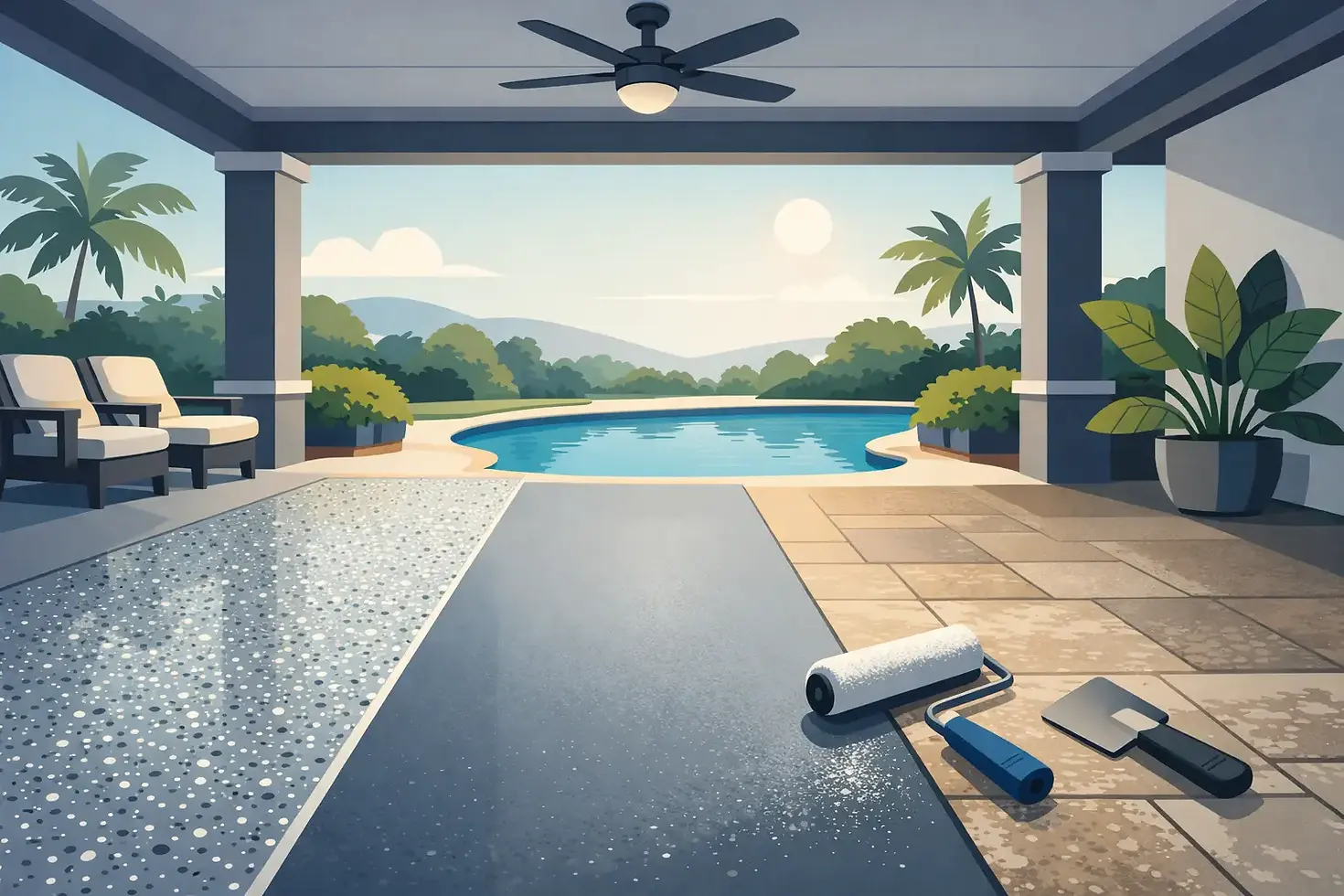
For homeowners who want more than a plain painted look, decorative flake systems are one of the most practical lanai floor coating options. Colored vinyl flakes are broadcast into the base coat, then sealed beneath a clear protective topcoat. The result is a textured, finished floor that helps disguise small imperfections, dust, and everyday debris better than a solid-color surface.
Flake floors also give homeowners real design flexibility. Neutral blends can complement stone, stucco, pavers, and outdoor furniture without overwhelming the space. Because the flakes create visual variation, they are often more forgiving than a single solid color on a high-use lanai.
Texture can be adjusted based on how the lanai is used. A poolside entry or frequently wet space may need more traction than a covered sitting area. The goal is not an aggressively rough floor that is hard to sweep. It is a surface with dependable grip where water and bare feet are part of daily life.
Why Concrete Preparation Decides the Outcome
The coating material matters, but the concrete preparation determines whether that material can perform. A premium coating applied to weak, contaminated, or smooth concrete is still at risk of failure.
Professional preparation starts with mechanical grinding. This opens the pores of the concrete and removes weak surface material, old coatings, and embedded contaminants. Cracks and damaged areas should be addressed before the coating system is installed, not hidden beneath a top layer and left to move underneath it.
Moisture must also be taken seriously. A lanai slab may look dry on the surface while moisture vapor moves through it from below. The installer should assess the slab and select materials that are appropriate for the conditions. Skipping this step may save time on installation day, but it often costs homeowners a failed floor later.
This is where contractor experience has real value. A coating is not just a bucket of product. It is a system of preparation, repair, base coat, decorative layer, topcoat, and application timing. Each layer must work with the concrete and with the layer beneath it.
Choosing the Right Finish for Your Space
Start with exposure. If your lanai receives direct sunlight, prioritize UV-stable materials such as polyaspartic topcoats. If moisture and pool traffic are frequent, make traction and adhesion non-negotiable. If the concrete has existing stains, hairline cracks, or a worn appearance, a decorative flake system can provide a more complete visual upgrade than a thin solid-color coating.
Also consider how you want to maintain the floor. A properly installed coating makes routine cleaning easier because it seals the porous concrete surface where dust and grime collect. Sweeping and occasional mopping are generally all that is needed. Avoid harsh cleaners and abrasive tools that can dull a finish over time.
The lowest upfront price is rarely the best value. Thin coatings, rushed prep work, and generic paint products often lead to a second project when the floor begins to peel or chip. A professionally installed industrial-grade system costs more because it is built to stay bonded, stay attractive, and protect the concrete beneath it.
Your lanai should feel like part of your home, not an unfinished slab you work around. A free on-site estimate can identify the concrete condition, moisture concerns, and coating system that fits your space. Choose a floor built for Florida living, then enjoy the confidence of a surface made to last.


Comments